
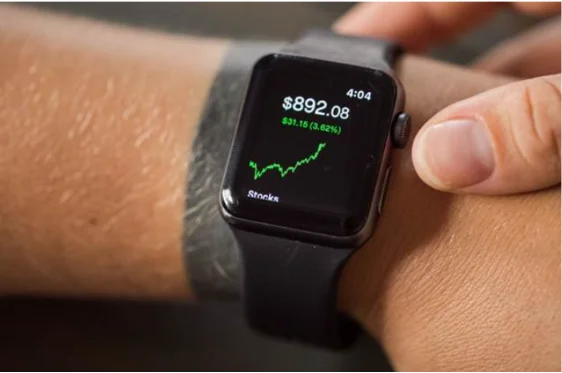

Wearables just about one year ago were nothing more than devices to track steps on a fitness band. This particular unit on your wrist today can check and trace your pulse, assess and analyze the oxygen amounts at the disposal of blood, facilitate you to run a health class, and make even the earliest signs of virus symptoms even prior to symptoms appear. Wearables evolved from small area segment a small bit a good deal to just about just about perhaps the most guarded section connected with client technology. The actual consumer items seem to be to be able to successfully combine medical, the form industry and technology straight into any unit anybody put on each day of any individual.
This change is clearly reflected by the data we have to analyse industry. According to expert market research the total value of the world wearable technology market was reported to be 339.17 million units in 2025 and predicted to continue with compound annual growth rate (CAGR) of 17.00% for 2035 to 1,630.33 million units. This level of ongoing increase therefore suggest that wearables are now, increasingly no more just part of an individual’s lifestyle, but an increasingly essential part of the process for how an individual tracks and maintains.
Understanding the Current Wearable Technology Market Landscape
Five converging trendlines driving year over year adoption Some of this simply reflects that trends are coalescing to drive growth each year. By understanding what these trend lines are one can get the context around why the smart wearable category has gone from a tech geek gadget to a mass-market device:
• Rising health consciousness: More consumers are self-monitoring their heart rates, sleep patterns and activity levels in efforts to monitor and manage their wellbeing
• Smaller, smarter sensors: As these tiny chip and biosensor advancements improve the amount of functions available in small comfortable designs.
• Integration with healthcare systems: Wearable devices are increasingly being adopted by both hospitals and insurers for real-time remote monitoring of patients for better preventive care and management of medical conditions.
• Affordability and variety: The wider range of price points, from ultra-cheap activity trackers to far more expensive smartwatches, has also meant that smartwatches are a more accessible option for many.
• 5G and connectivity gains: The networks will allow more real time data syncing and will move wearables’ analytics back into cloud’.
Key Trends Shaping the Industry in 2026 and Beyond
There are number of trends that will shape the next phase of growth; and as early movers companies that ride on these emerging trends will grab the largest proportion of new demand
• Smart rings and discreet form factors: More popular amongst a variety of users will, no doubt, be smart rings for the individual that wants to be tracked but does not want the additional mass.
• AI-powered health insights: It may seem as though on-device AI is only taking raw sensor data and converting it to big, boring numbers on a page. It’s not as if a huge pile of pixels turns into something that helps us make a decision. But in many cases, that’s precisely what’s happening.
• Medical-grade monitoring: FDA approval for functionality like ECG and even continuous glucose monitors would continue this convergence of gadgets with medical devices.
• Fashion-forward designs: The collaborations between brands, which you may see below, and fashion houses are being driven by an increasing focus to disguise these smart wearables as trendy accessories rather than obvious technological products.
• Extended battery life: Better chipset low power management means the time you can go without charging jumps from a few days to a few weeks-a key killer of adoption is finally addressed.
Where the Wearable Technology Market Is Being Applied
Wearables are no longer confined to fitness enthusiasts. Their use cases now span multiple sectors:
• Healthcare: Remote patient management, management of chronic illnesses and the earliest possible detection of irregular heart functions.
• Sports and fitness: What is important is tracking of performance of the athlete and how he is recuperating and his programmes of recovery and training to maximize gains, prevent injury and minimise down time.
• Enterprise and industrial: Smart construction hard hat and wristband device will monitor fatigue and other safety variables for workers
• Defense and public safety: Wearable sensors that track location data and vital signs for first responders, and soldiers.
• Consumer lifestyle: Smartwatches /buds integrating with payments, Notifications, VOICE assistants to all devices.
Regional Outlook: Where the Growth Is Concentrated
North America led the wearable tech marketplace with healthy consumer expenditure and penetration for healthcare wearables. Asia Pacific recorded an increase of fastest expansion from manufacturers on account of the huge industry size, high disposable incomes, and smartphones boom in China and India. Meanwhile, Europe followed an exclusive niche with penetration as the highest market among those with wearables that feature superior features that catered to an ever-increasing and aged demography backed by favorable healthcare policies.
Challenges That Could Slow the Momentum
Although all signs point toward solid growth, a couple of pain points linger; Data privacy about constant device connection, poor performance of budget models at collecting certain types of health information, and the short product update life cycle which turns current products into e-waste. Battery life for smartwatches continues to bother users who demand a certain degree of the smartphone type-usage without having to charge their device daily.
Conclusion
Today, the wearable technology marketplace is no longer just a fad driven by athletic activity but is gradually transitioning into the underlying framework for personal health and connected lifestyle applications. As wearables become increasingly proficient and fashionable and integrate into healthcare systems at a more rapid rate, personal tracking devices are about to reach par with the usage status of a mobile phone in personal, health-related & lifestyle services. Companies and investors intending to get a jump start in profiting from the available space, now have access to thorough forecasts and comprehensive supporting material, readily available for them in market research reports from Expert Market Research.
Frequently Asked Questions (FAQs)
1. How much the wearable technology market is today?
It was 339.17 million units in 2025, and growth has been consistent.
2. What is the growth rate for Wearable technology?
Wearable technology market size is likely to grow by 17.00% between 2025 and 2035, to roughly 1,630.33 units in 2035.
3. So the areas with most widespread use for wearable devices What types of businesses or application areas?
Healthcare sport and leisure, workplace safety, military, defense or consumer applications (normal day to day usage).
4. What are the latest wearable device trends?
What you will surely be seeing is more medical grade monitoring, smart ring use and also medical devices, the data that your device can interpret by your health, AI integration as well as technology with style.
5. What are the challenges in wearable industry?
Key challenges – data security, accuracy and reliability in cheaper devices, short battery lifespan, e-waste.