

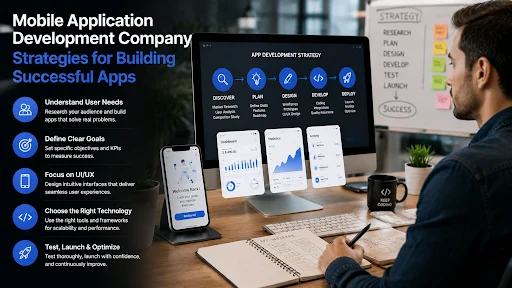

A founder I know shipped a beautifully designed app, got featured on a few startup blogs, and then watched it lose ninety percent of its users within two weeks. The design wasn’t the problem. The strategy behind the build was.
Table Of Content
- Start With the Problem, Not the Feature List
- Treat Platform Choice as a Strategic Decision, Not a Default
- Build the Onboarding Flow Like It’s the Whole Product
- Plan for Testing Earlier Than Feels Necessary
- Design for Retention From the First Sprint
- Build a Realistic Maintenance Plan Before Launch, Not After
- Use Data to Guide Decisions, Not Just to Report on Them
- Choose a Partner Who Asks Hard Questions Early
- The Strategies That Actually Hold Up
That gap between “we built an app” and “we built an app people actually keep using” is where most projects quietly fail, and it rarely comes down to one dramatic mistake. It’s usually a string of smaller decisions made early, often by a team that knew how to code but hadn’t thought through what happens after launch. The strategies that separate a successful app from an abandoned one tend to get decided well before a single screen gets designed, and a capable Mobile Application Development Company is usually the difference between getting those decisions right and finding out the hard way six months in.
Here’s what actually matters, based on what’s working right now rather than what sounds good in a pitch deck.
Start With the Problem, Not the Feature List
Plenty of app projects begin with a founder describing features they want. Fewer begin with someone clearly naming the specific problem the app needs to solve and for whom.
This sounds obvious until you watch how many builds skip it. Teams jump straight into wireframes for a social feature or a gamification layer before anyone’s confirmed the core problem is real or that people will actually change their behavior to solve it. The apps that succeed tend to come from founders who can describe their user’s frustration in one clear sentence, not a list of twenty features they think would be nice to have.
A good development partner will push back here. If a team agrees to build everything you ask for without ever questioning the underlying assumption, that’s not a strength. That’s a team that’ll happily build something nobody needs.
Treat Platform Choice as a Strategic Decision, Not a Default
Native iOS, native Android, or a shared codebase across both — this decision gets made too casually far too often, usually based on whatever the team already knows rather than what the project actually needs.
Native development gives tighter performance and deeper access to device capabilities, which matters enormously for anything camera-heavy, anything doing real-time processing, or anything where smoothness is the whole point. Shared-codebase approaches can get a product to market faster and cheaper, which makes sense for a lot of straightforward utility apps where performance ceiling isn’t the bottleneck.
The mistake is picking based on convenience rather than fit. Ask any potential partner to walk through why they’re recommending one approach over the other for your specific use case, not just which one their team happens to be staffed for.
Build the Onboarding Flow Like It’s the Whole Product
Most teams treat onboarding as a quick intro screen tacked on near the end of development. The data on this is pretty unambiguous: a confusing first five minutes is one of the biggest predictors of someone deleting an app and never coming back.
Strong onboarding does a few things well. It gets a new user to a meaningful first result fast, ideally within their first session, rather than asking them to set up six preferences before they’ve seen any value. It explains permissions in plain language right when they’re needed instead of front-loading a wall of requests nobody reads. And it resists the urge to explain every feature at once, because nobody remembers a tutorial that covers everything on day one.
If a development team treats onboarding as an afterthought scheduled for the final sprint, that’s usually a sign they’re thinking about shipping rather than retention.
Plan for Testing Earlier Than Feels Necessary
Most teams test late and pay for it later in ways that are far more expensive to fix after launch than during development.
Solid Mobile Application Testing Strategies weave testing into the build from early on rather than treating it as a final gate before submission. That means unit tests written alongside the code rather than after, real device testing across a meaningful range of phones and operating system versions rather than just the latest flagship, and usability testing with actual target users rather than just the internal team who already knows how the app is supposed to work.
The teams that skip this tend to discover their real bugs in app store reviews instead of in a test environment, which is a much more public and much more expensive place to find them.
Design for Retention From the First Sprint
Acquisition gets most of the attention because it’s easier to measure and easier to put in a pitch deck. Retention is where the actual business lives or dies, and it needs to be designed for from the start rather than patched in after launch numbers come back disappointing.
This means building habit triggers thoughtfully, not as an afterthought bolted onto a finished product. Push notifications that actually add value rather than nagging people back. Progress indicators that make continued use feel rewarding rather than tedious. Features that genuinely improve the more a person uses them, which gives someone a real reason to stick around rather than abandon the app after the novelty wears off in week one.
A development partner who only talks about launch and never asks how you’ll measure thirty-day retention is planning for a press release, not a sustainable product.
Build a Realistic Maintenance Plan Before Launch, Not After
Launch day feels like the finish line, but for any app actually trying to stay relevant, it’s closer to the starting line of the harder part.
Operating system updates break things without warning. Device manufacturers ship changes that affect performance in ways nobody predicted during development. User feedback after a real launch reveals problems no amount of internal testing ever surfaces, because real users behave in ways test plans rarely anticipate. Budgeting for ongoing maintenance, regular updates, and ongoing performance monitoring from the outset prevents the unpleasant surprise of discovering, three months post-launch, that nobody planned for what happens after the launch party ends.
Use Data to Guide Decisions, Not Just to Report on Them
Most apps collect analytics. Far fewer actually use that data to make meaningful product decisions, and the gap between those two things is bigger than most teams realize until late in a project.
The difference between a vanity dashboard and a genuinely useful one comes down to whether the metrics being tracked actually connect to decisions someone’s prepared to act on. Where exactly are people dropping off in a flow, and why might that be happening. Which features get used repeatedly versus tried once and abandoned. What does the data actually suggest about what to build next, rather than just confirming what the team already wanted to build anyway.
Teams that build this kind of feedback loop into their process from the start tend to ship updates that meaningfully improve the product. Teams that only check analytics when something’s visibly broken tend to keep guessing.
Choose a Partner Who Asks Hard Questions Early
The clearest signal of a development partner worth trusting isn’t how impressive their portfolio looks. It’s whether they ask uncomfortable, specific questions before the first line of code gets written.
Do they ask who the app is actually for, specifically, rather than accepting “everyone” as an answer. Do they push on what happens after launch, not just what happens before it. Do they have a clear, honest point of view on platform and architecture decisions rather than just deferring to whatever you say you want. Teams that skip these conversations tend to build exactly what was asked for and nothing more, which sounds reasonable until you realize what was asked for often isn’t quite what the project actually needed.
The Strategies That Actually Hold Up
Building a successful app has very little to do with chasing the newest framework or cramming in every feature a competitor has. It comes down to a small set of decisions made early and made deliberately: knowing precisely who the app is for, choosing a platform strategy that fits the actual use case rather than the team’s comfort zone, designing onboarding and retention with real intention, testing early rather than late, and planning honestly for what happens after launch rather than treating it as someone else’s problem.
The apps that last are not usually the ones with the flashiest feature set. They are the ones built by teams who asked the harder questions before writing any code, and kept asking them throughout the entire software development process, from planning and design to launch and long-term maintenance.