

When someone visits an adult website, they usually think about what appears on the screen. Search engines look at something very different. Before a page can become visible in search results, automated crawlers examine its technical structure, content, links, accessibility, and many other signals.
Table Of Content
- How Google Crawls a Website
- What an Adult SEO Agency Looks at First
- Robots.txt
- XML Sitemap
- Internal Links
- Google Looks at Page Structure
- Title Tags
- Headings
- Meta Descriptions
- Duplicate Content Can Create Crawling Challenges
- Canonical Tags
- Redirects
- Content Still Matters
- Avoid Keyword Stuffing
- Keep Important Content Accessible
- How Page Experience Fits Into the Picture
- Google Also Follows Links
- Structured Data Can Provide Additional Context
- Security and Accessibility Matter Too
- What an SEO Audit Should Reveal
- How Triple Minds Approaches SEO for Specialized Websites
- What Website Owners Should Check Regularly
- Final Thoughts
For adult websites, this process can be especially important because the industry operates in a highly competitive digital environment. A website may have valuable content and a good user experience, but technical problems can still make important pages difficult for search engines to discover, understand, or index.
Understanding what happens during crawling can help website owners identify problems before they turn into long-term visibility issues. From robots.txt and internal linking to canonical tags and page performance, every technical detail can influence how efficiently a website can be crawled.
How Google Crawls a Website
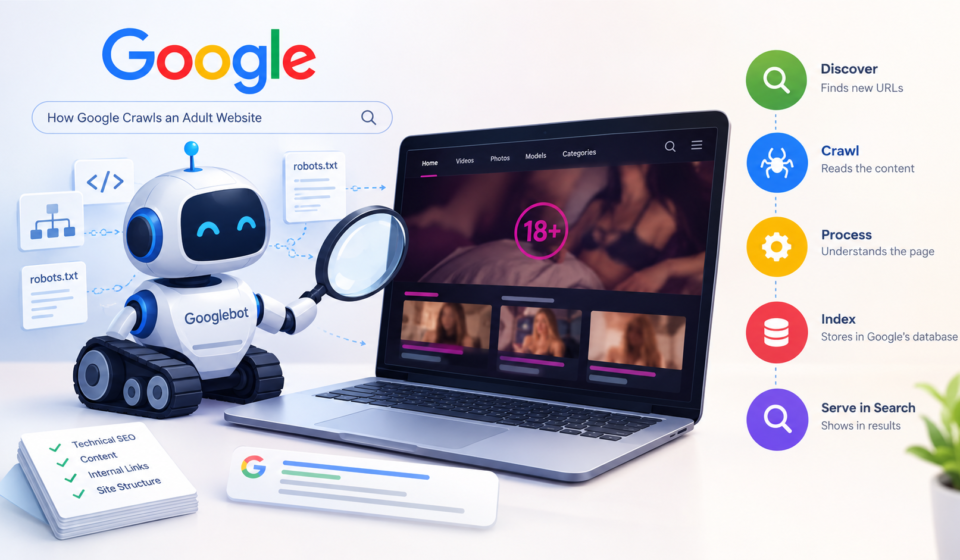
Google uses automated systems, commonly referred to as crawlers, to discover publicly accessible web pages. Googlebot can find URLs through links, sitemaps, and other discovery mechanisms before attempting to crawl those pages.
Crawling does not automatically mean that a page will appear in search results. Crawling, indexing, and ranking are separate stages.
A simplified process looks like this:
Discover → Crawl → Process → Index → Serve in Search
For a closer look at how search engines discover and process webpages, this video provides a useful overview of the crawling and indexing process: Watch the video on YouTube.
For website owners, understanding these stages makes SEO problems easier to diagnose.
What an Adult SEO Agency Looks at First
An adult SEO agency typically needs to look beyond keywords and content. Technical accessibility is an important starting point because search engines need to be able to reach and process the pages that a website wants indexed.
Robots.txt
The robots.txt file can provide instructions about which areas crawlers are allowed or disallowed from accessing.
An incorrectly configured file can unintentionally prevent important pages from being crawled. Website owners should therefore review it carefully whenever major changes are made to the site.
XML Sitemap
An XML sitemap provides search engines with a list of URLs that a website considers important.
A properly maintained sitemap can help search engines discover relevant pages, particularly on large websites where thousands of URLs may exist.
However, adding a URL to a sitemap does not guarantee that Google will index it.
Internal Links
Internal links help crawlers move between pages and understand how different sections of a website are connected.
A strong internal linking structure can make important pages easier to discover while also helping users navigate the website.
Google Looks at Page Structure
Search engines do not see a webpage exactly as a human visitor does. They process the underlying HTML, rendered content, metadata, structured data, links, and other technical elements.
Title Tags
The title tag helps communicate the subject of a page. Every important page should have a relevant and descriptive title rather than relying on automatically generated or duplicated titles.
Headings
Logical heading structures help organize content.
Using one clear H1 followed by relevant H2 and H3 sections can make a long page easier to understand for both users and search engines.
Meta Descriptions
Meta descriptions do not function as a direct ranking factor in the traditional sense, but they can influence how a search result is presented and whether users decide to click.
Unique descriptions can therefore support a better search experience.
Duplicate Content Can Create Crawling Challenges
Large websites can sometimes generate multiple URLs showing similar or identical content.
For example, filters, parameters, pagination, sorting options, and session-based URLs can create many variations of the same page.
This can make a site harder to manage from a crawling perspective.
Canonical Tags
Canonical tags can indicate which version of substantially similar pages should be treated as the preferred URL.
They are signals rather than absolute commands, so they should be implemented consistently with other technical signals.
Redirects
Old or duplicate URLs may need appropriate redirects when pages are permanently moved.
Poor redirect chains, redirect loops, or unnecessary redirects can create technical problems and negatively affect the user experience.
Content Still Matters
Technical SEO may help Google access a website, but content determines what individual pages are about.
An adult seo marketing company may evaluate whether pages provide useful, original, and clearly organized information instead of focusing solely on keyword placement.
Avoid Keyword Stuffing
Repeating the same phrase excessively does not create better content.
A stronger approach is to cover the topic naturally, answer user questions, and use related terminology where it genuinely helps readers understand the subject.
Keep Important Content Accessible
If important information is hidden behind interactions that search engines cannot properly process, the page may not communicate its full value.
Website owners should make sure essential text and supporting information are available in a crawlable format.
How Page Experience Fits Into the Picture
Crawling and indexing are not the same as user experience, but technical performance still matters.
Slow-loading pages can create frustration, particularly on mobile devices. Large media files, inefficient scripts, poor server response times, and excessive third-party resources can contribute to performance problems.
Website owners should monitor metrics such as:
- Loading performance
- Interactivity
- Visual stability
- Mobile usability
- Server response times
The objective should be to create pages that are accessible and usable rather than optimizing technical metrics in isolation.
Google Also Follows Links
Links provide pathways through a website.
A page that receives relevant internal links from important sections of the site may be easier for crawlers to discover than an isolated page with no meaningful internal connections.
This is why website architecture matters.
For large adult websites with many categories, profiles, media pages, and informational resources, creating a logical hierarchy can make the overall site easier to navigate.
Structured Data Can Provide Additional Context
Structured data allows websites to provide machine-readable information about their content.
Depending on the page type and eligibility, structured data can help search engines better understand entities and page characteristics.
However, structured data should accurately represent visible page content and follow Google’s guidelines. Adding markup simply to manipulate search appearance can create problems.
Security and Accessibility Matter Too
Google needs to access pages successfully.
Common technical issues include:
- Server errors
- Broken links
- Incorrect redirects
- Blocked resources
- Accidental noindex directives
- DNS or hosting problems
- Inaccessible JavaScript resources
A website can have excellent content and still experience search visibility problems if important pages consistently return errors or cannot be accessed properly.
What an SEO Audit Should Reveal
A technical SEO audit can provide a clearer picture of how a website is being crawled and interpreted.
A useful audit may examine:
- Crawlability
- Indexability
- Canonical implementation
- Robots.txt
- XML sitemaps
- Internal linking
- Broken URLs
- Redirects
- Duplicate pages
- Page speed and mobile experience
- Metadata
- Structured data
The goal is not simply to generate a long list of technical errors. The more useful objective is to identify which problems can have the greatest impact on important pages.
How Triple Minds Approaches SEO for Specialized Websites
For businesses operating in specialized industries, Triple Minds can approach SEO by combining technical analysis, content strategy, website architecture, and ongoing optimization.
The first step should be understanding how the website currently performs. From there, teams can identify crawlability issues, content gaps, indexing inconsistencies, internal linking opportunities, and other technical areas that may need attention.
A sustainable strategy should focus on improving the website as a whole rather than relying on shortcuts or excessive keyword optimization.
What Website Owners Should Check Regularly
SEO is not a one-time task. Websites change constantly as new pages are published, old URLs are removed, templates are updated, and technical systems evolve.
Regular checks can help catch problems early.
Website owners should periodically review:
- Whether important pages are indexed
- Whether canonical tags point to the intended URLs
- Whether robots.txt blocks important resources
- Whether XML sitemaps contain valid URLs
- Whether internal links lead to working pages
- Whether important pages have unique metadata
- Whether pages remain accessible on mobile devices
- Whether server errors have increased
- Whether new duplicate URL patterns have appeared
Final Thoughts
When Google crawls an adult website, it is not simply looking for keywords. It is processing a combination of technical signals, content, links, page structure, accessibility, and other information to understand the website.
That makes technical foundations just as important as publishing content.
For adult websites competing for organic visibility, understanding how crawling and indexing work can make SEO decisions more practical. Instead of chasing rankings alone, website owners can focus on making important pages discoverable, accessible, understandable, and useful.
The search landscape will continue to change, but a technically sound website with useful content gives businesses a stronger foundation for adapting to those changes.